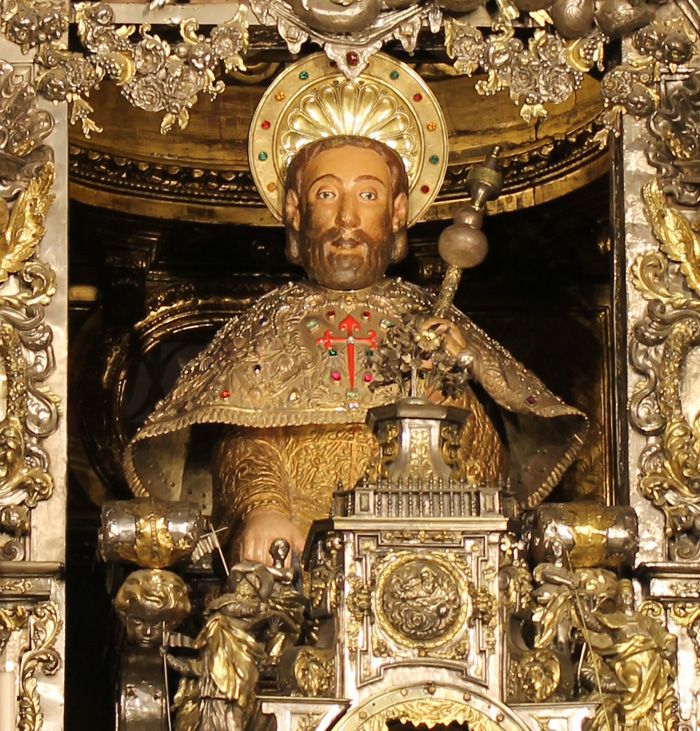
As with many saints, the life of St James is a mixture of facts and fiction, the untangling of which requires painstaking scholarship.
Today, I want to investigate the life of St James using three simple questions: Who was St James? What was James’ response to Jesus? – and, perhaps most importantly – What does his legacy mean for Christians today?
So, to our first question, who was St James?
According to the gospel himself and his brother John, along with Peter and his brother Andrew, were the first to be called by Jesus to follow him. All four were fishermen, and the father of James and John, Zebedee, seems to have had a thriving fishing business because the gospel refers to him as having hired men working for him.
James and John were among the twelve that Jesus chose from his wider group of disciples. According to the gospel, Jesus took Peter, James and John up the Mount of Transfiguration and he brought the same three with him into the garden of Gethsemane. So, James was one of three disciples who had privileged access to Jesus. Yet, according to this morning’s gospel reading, working through their mother, James and his brother John approach Jesus looking for the best seats in the kingdom! For all their special access to Jesus, neither of them seemed to have grasped that following Jesus had nothing to do with seats of honour and everything to do with being ready to drink the cup that Jesus had to drink, the cup of suffering.
So to our second question, what was James’ response to Jesus?
I want you to think for a moment of the most important decision you can ever remember taking. Perhaps it was to get married, or have children. Or was it to move to a new town or country, or to train for a new job? Might it even have been to become a Christian? Take a few moments to think quietly…
Now consider James. Evangelist Mark is so sparing in his words: they left their father Zebedee in the boat with the hired men, and followed him. James and his brother take the life-changing decision in an instant to follow this rabbi who was previously unknown to them. Had they got any idea of his reputation? I don’t think so. Did they think about the consequences? I don’t think so. Would James have taken a different path had he known that on account of Jesus he would die by the sword less than 15 years later? I don’t know…
What does become clear – and now I turn to today’s gospel from Matthew – is that perhaps James’ motives were not altogether pure. Matthew places the request into the mouth of James and John’s mother Salome, but in Mark’s gospel it is James and John themselves who request privileged places at Jesus’ left and right hands in the kingdom. Should we to understand that by joining the twelve, James and his brother had fantasies of power?
The other disciples are angry, but Jesus reassures them with the promise that those who are great are in fact servants of others. We know little of James’ specifically after the resurrection, but we do know that, as a servant of the early church, he met his end for his beliefs. James went on to drink that cup of suffering. According to the Acts of the Apostles, King Herod Agrippa persecuted the church in Judea and had James killed with a sword. He was the first member of the twelve to die for his faith in the Lord.
And finally to our third question, what does James’ legacy mean for Christians today?
Among the pilgrims going up to the shrine of Santiago de Compostella, there are, as with us all, a mixture of motives, some good, some bad. Many no doubt go to honour God and seek his will, asking for James’ prayers in their quest to become better human beings. Others perhaps go out of curiosity, to enjoy the spectacle of the cathedral and its ceremonies, not least the incense and others, I’m sure, enjoy a walking holiday in the Pyrenees with a bit of history and a sense of destination at their journey’s end. For most, if they’re honest, there is probably a mixture of all these.
I asked you earlier to think of a key decision in your own life. Now think what motivated you to make that decision – again, take a few moments to think quietly…
Being a Christian makes our motives no more pure or noble than anyone else’s, just as for James, he may have been drawn to thoughts of power and influence as much as service and sacrifice. But the example of James teaches us that making bold decisions matters.
First century Judaea, a bit like today’s England, was a place of political and economic turmoil. Out of the ferment of that time of change, led by James and his fellow apostles, emerged a gospel and a Church which would change the face of Europe and indeed the world in the centuries to come. To decide to own the name of Christ today lifts us above the narrow vision of fear which is dragging so many people into suspicion and barrier-building. Instead we become part of an inclusive and justice-focused movement where, as Jesus himself teaches us, we are not to be served, but to serve. Despite his shortcomings James joined that movement, and we can be his heirs in taking the decision to follow Jesus in the way that leads to fullness of life for all God’s children.
 Tomasz MAMELKA - Timperley
Very much enjoyed today’s post, Father. My daughter, Gemma Masterson, forwarded to me .I belong to Sacred Heart and St. Peter’s Parish.
LikeLike