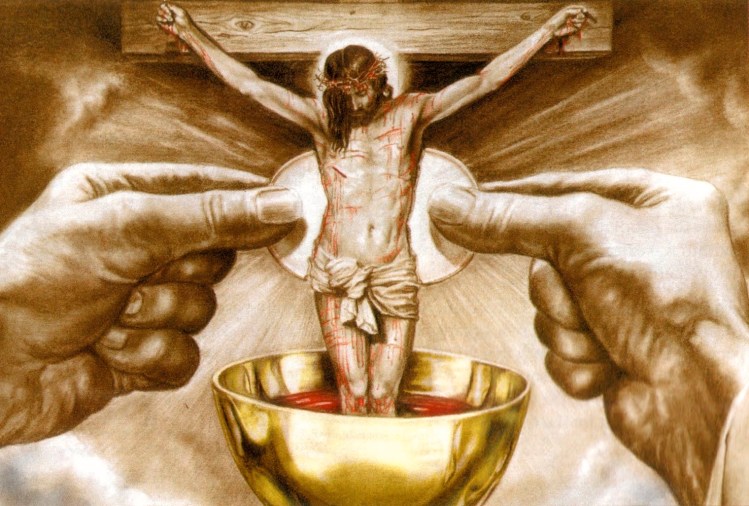
My Catholic Church which I love – if I don’t, I wouldn’t be a priest – has precious treasure – the Holy Mass. This Church describes Mass as being ‘the source and the summit of the Christian life’. But what does it mean exactly?
Firstly it means that: all other sacraments we have (baptism, confirmation, reconciliation, anointing of the sick, matrimony and priesthood) are not equal to the Mass! They are only bound up with the Mass and are oriented toward it, because the whole spiritual good our Church has, is contained in the Mass.
Secondly – above description of Mass means also, that this sacrament is the sum and summary of whole our faith, because in the Mass, on many various ways Jesus Christ himself is present. And obviously, Jesus Christ for us – believers – is everything.
This truth, that Mass is the source and the summit of Christian life, we can discover deeply in all the names we use for Mass. These names express inexhaustible richness of Mass.
First of all, we call Mass The Lord’s Supper, because of its connection with the last supper which Jesus took with his disciples on the eve of his death. We believe that every celebration of the Mass is both that same supper and the anticipation of the banquet that the Lord will celebrate with the redeemed at the end of time. During every Mass all members of heaven (Our Lady, all the angels, all the Apostles and Saints) are gathered invisibly around the altar. They are with us for Lord’s Supper.
Another name we use is the Holy Sacrifice because Mass is connected with Christ’s death and our own offering. We believe that on the Cross, Our Lord offered Himself for all mankind. The Sacrifice of Calvary was offered up by the separation of Jesus’ blood from His body. In every Mass, this death is mystically and sacramentally commemorated, by the separate consecration of bread and wine. Note that the bread and wine are not consecrated together at the same time, but rather, following the words of Jesus: “This is My Body” is said over the bread first; and then “This is My Blood” is said over the wine. The separate consecration is a kind of mystical division of body and blood, which is the way Our Lord died on Calvary. So we call Mass the Holy Sacrifice, because Jesus offered Himself on Calvary, and now this sacrifice is represented in the Mass.
But we have to remember that each Mass is not another real death of Christ but a new presentation of the eternal Victim He became on the Cross. On the Cross, He physically redeemed all humanity, He really died; in the Mass we actualize that Redemption; we apply that death to ourselves, and unite our sacrifice with His. And there is a question related to Christ’s Sacrifice: what can we offer to Our Lord for everything He has done for us? Thousands of martyrs gave their lives to repay Jesus for his love and sacrifice. What about us? How can we respond to His infinite love? So we also call the Mass Sacrifice because after Holy Communion we have to sacrifice ourselves to Jesus in daily life. Mass leads us to the sacrifice. St Teresa of Avila told us: ‘Today, Christ has no body now but yours…Yours are the hands, yours are the feet, yours are the eyes, you are His body. Christ has no body now on earth but yours’.
Eucharist is another name for the Mass. It comes from two Greek words eucharistein (thanksgiving) and eulogein (high praising). The Eucharist then, is an action of thanksgiving and praise to God. It recalls the Jewish blessings that proclaim God’s works: creation, redemption, and sanctification. And we all have many reasons to be grateful to God. That’s why people very often ask a priest to say Mass for a special intention, for example: thanksgiving for healing, for a marriage, and so on.
The last name for the Eucharist we use mostly is – Mass (Latin: Missa). It comes from the Latin word – mittere (sending). Some people interpret the name Missa as the prayers we send to God during the Mass, but a better interpretation is that it comes from the Latin sentence “ite, missa est” which used to finish all assemblies. This is the sending forth (missio) of the faithful, so that they may fulfil God’s will in their daily lives after they meet God at the table of His Body and Blood.
After this description I have to direct your attention on the heart of every Mass.
So, what is the heart of every Mass? Well, as a Catholics we believe that the real presence of Christ in the consecrated bread and wine is the heart of every Mass. We know that during Mass at the special moment of consecration the bread and wine (mixed with a drop of water) are changed into Christ who from that moment is present, whole and entire, in the forms of bread and wine. We believe these are not just bread and wine any more, they are Body and Blood, Soul and Divinity of Jesus.
This is one of the important differences between Catholics and most Protestants. To most of our Protestant brothers and sisters, the Eucharist is a symbolic meal in which the bread and wine somehow remind them of the sacrifice of Christ. But for us – Catholics – the bread and wine are the living Christ; not just symbols of Christ. Since this is true for us, receiving Holy Communion means entering into communion in Jesus Christ, in person, who shares himself with us in his love. In Holy Communion we unite ourselves with Christ, who shares his Body and Blood with us to form a single body – the Church.
But we have to say honestly, that this miracle of transformation of bread and wine into the Body and Blood of Jesus Christ is something that we here on earth cannot understand very well. No wonder Pope Paul VI referred to the Eucharist as not just a great mystery, but The Mystery of Faith. So, this is our faith and the heart of every Mass.
So why do Catholics believe in the real presence of Jesus, instead of just saying that the bread and wine are symbols of His body and blood? The answer is simple. We believe in the real presence because we accept the words of Christ in Scripture. Jesus was not ambiguous when he told his disciples what He was doing. “Now as they were eating, Jesus took bread, and blessed, and broke it, and gave it to the disciples and said: ‘Take, eat; this is my body’. And he took a chalice, and when he had given thanks he gave it to them, saying: ‘Drink of it, all of you; for this is my blood of the covenant, which is poured out for many for the forgiveness of sins. I tell you I shall not drink again of this fruit of the vine until that day when I drink it new with you in my Father’s kingdom.” (Matthew 26:26-29)
Long before the Last Supper, Jesus had told his disciples what to expect. In what we call the “Bread of Life discourse”, Jesus shocked most of his followers by telling them they were going to have to eat his flesh and drink his blood: “‘This is the bread which comes down from heaven, that a man may eat of it and not die. I am the living bread which came down from heaven; if any one eats of this bread, he will live for ever; and the bread which I shall give for the life of the world is my flesh’. The Jews then disputed among themselves, saying: ‘How can this man give us his flesh to eat’? So Jesus said to them: ‘Truly, truly, I say to you, unless you eat the flesh of the Son of man and drink his blood, you have no life in you; he who eats my flesh and drinks my blood has eternal life, and I will raise him up at the last day. For my flesh is food indeed, and my blood is drink indeed. He who eats my flesh and drinks my blood abides in me, and I in him. As the living Father sent me, and I live because of the Father, so he who eats me will live because of me. This is the bread which came down from heaven, not such as the fathers ate and died; he who eats this bread will live for ever.’” (John 6:50-58)
When Jesus has been so completely straightforward and explicit, it’s hard to think that he was speaking metaphorically. As Catholics we believe then, that Jesus Christ meant what he said, that the bread and wine really are His body and blood.
 Tomasz MAMELKA - Timperley